The cladding crisis exposed serious weaknesses in how the construction industry understands and manages fire risk. Since then, attention has focused on identifying unsafe buildings and removing the materials that contributed to the problem. But are we looking closely enough at the wider façade system, including the materials hidden from view, and applying those lessons to the buildings we are designing and constructing today?
The cladding crisis has fundamentally changed the way the construction industry approaches building safety. It exposed serious weaknesses in product selection, specification, testing, installation and accountability, while forcing building owners, developers and contractors to confront problems that, in some cases, had remained hidden for years.
There is no question that progress has been made. Unsafe materials are being removed, buildings are being assessed and regulations have been strengthened. The industry is also much more conscious of the importance of fire performance and the need to understand how materials behave when exposed to fire, but should we be asking another question?
Cladding has become synonymous with façade fire safety, yet an external wall is made up of far more than its outer finish. Insulation, membranes, supporting structures, fixings, cavities, cavity barriers and fire-stopping all contribute to the performance of the complete construction. If we focus primarily on the cladding itself, we could be in danger of overlooking other materials and interfaces that could influence how a fire develops and spreads.
We had warnings before Grenfell
It would be wrong to suggest that the dangers associated with external fire spread only became apparent after the Grenfell Tower fire in June 2017. The Grenfell Tower Inquiry examined several earlier incidents that demonstrated how fire could spread across the outside of buildings, sometimes with fatal consequences.
At Garnock Court in Irvine in 1999, a fire spread up the exterior of a residential tower block following the installation of external cladding. One resident died and several others were injured.
At Lakanal House in Camberwell in 2009, six people lost their lives in a fire involving combustible window infill panels and failures of compartmentation. Although this was not a straightforward example of a modern rainscreen cladding fire, it demonstrated the danger of combustible components within external walls and the consequences of fire escaping the compartment where it started.
The Shepherd's Court fire in west London in August 2016 provided another particularly important warning. A fire originating in a flat spread up the external façade of the 20-storey residential building. The subsequent investigation found that the panels contained polystyrene insulation, which was likely to have assisted the fire's spread. The Grenfell Tower Inquiry examined this incident as part of its consideration of earlier warnings about external wall materials.
Further incidents after Grenfell reinforced the point. At The Cube student accommodation in Bolton in November 2019, fire spread rapidly across an external wall system incorporating high-pressure laminate cladding. Greater Manchester Fire and Rescue Service reported that all 217 residents were accounted for, with no serious injuries. The incident nevertheless demonstrated the potential for extensive fire spread through materials other than ACM panels.
These incidents are not identical and it is important not to treat every external wall fire as evidence of the same technical failure, but collectively they demonstrate that the problem extends beyond one particular product category.
The Grenfell Tower Inquiry's findings also raise a more uncomfortable question. If previous incidents had already demonstrated the potential for rapid external fire spread, why did the construction industry fail to respond consistently and effectively? We cannot change those decisions, but we can make sure that the lessons are applied much more rigorously in future.
A façade is a system, not a collection of products
One of the most important changes in thinking must be a move away from considering façade materials in isolation. An external wall is a combination of components that must perform different functions while working together. The outer cladding provides the visible finish and protection. Insulation contributes to thermal performance. Supporting structures and fixings hold the system in place. Cavity barriers and fire-stopping help provide compartmentation and restrict the movement of fire, while membranes provide weather protection and assist with moisture management. Each component has a purpose, but its suitability cannot be judged without considering the surrounding construction.
A product may achieve a particular reaction-to-fire classification, but that does not automatically demonstrate that it is suitable for every façade application. Its performance needs to be understood in relation to the substrate, supporting structure, cavity arrangement, surrounding materials and installation method.
This matters because reaction-to-fire classifications and the fire performance of a complete wall assembly are not the same thing. Euroclass A1 and A2-s1,d0, for example, describe how a material behaves when exposed to fire under specified test conditions. They do not establish the fire resistance of an entire wall or guarantee that a completed façade is safe, irrespective of how it has been designed and installed.
We need to be much more precise about what product classifications demonstrate, how test evidence should be interpreted and whether the conditions of a particular project match those under which a product has been assessed. A classification is important evidence. It is not a substitute for understanding the complete construction.
What about the materials we rarely see?
The attention given to cladding has understandably brought the visible external finish into the spotlight, but some of the materials that deserve scrutiny are concealed once the building is complete. Façade membranes are one example.
Installed behind external cladding, they help protect the building fabric against wind-driven rain while allowing water vapour to escape. They contribute to moisture management and help protect insulation and supporting structures.
Their role in a building envelope should not be overlooked, but neither should their fire performance. Their material composition, classification, compatibility with surrounding components and permitted installation conditions all need to be understood as part of the wider façade design. The same principle applies to insulation, cavity barriers, fixings and other components. A material does not become unimportant because it cannot be seen from the outside.
This is an area where manufacturers have a clear responsibility. We need to provide more than a product and a datasheet. Specifiers need reliable test evidence, transparent technical information and clear installation guidance that explains the conditions under which a product is suitable for use.
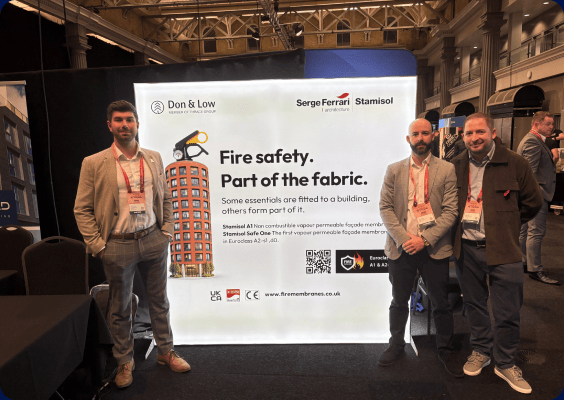
Through our partnership with Serge Ferrari Group, Don & Low is bringing the Stamisol A1 and Stamisol Safe One façade membranes to the UK market. They provide examples of specialist products developed with defined reaction-to-fire classifications: Euroclass A1 for Stamisol A1 and A2-s1,d0 for Stamisol Safe One.
Proshield® also has an important role within the wider market. Its self-adhesive construction, W1 water penetration resistance, vapour permeability and airtightness make it a practical option for ventilated façade applications where its performance and classification meet the specification.
However, the important point is not that one classification or product provides a universal answer. Their suitability depends on the particular façade design, the supporting construction and the specified installation conditions. No individual membrane can independently resolve the complexities of façade fire safety.
The wider responsibility is to ensure that every component is selected for the job it is expected to perform and supported by evidence that is relevant to the intended application.
Another lesson from the cladding crisis is that fire performance must be considered much earlier in the design and procurement process. If fire safety becomes a major consideration only after the external wall design has been developed, materials selected and costs agreed, there is a risk that decisions will be driven by the constraints of an existing specification. That can lead to substitutions, compromises or attempts to resolve technical problems late in the project.
Instead, reaction-to-fire performance, including combustibility and smoke production, needs to be considered from the outset, alongside structural requirements, thermal efficiency, weather protection, moisture management and durability.
Architects, façade consultants, contractors and manufacturers should be working together before key material decisions become fixed. They need to understand not only the performance of individual products, but also how the complete assembly is intended to work.
The construction industry has invested enormous resources in identifying and correcting unsafe buildings. Residents have endured years of uncertainty, disruption and, in some cases, considerable financial anxiety. We should be determined that future generations do not face the same experience. That means moving beyond a narrow focus on cladding and developing a much more complete understanding of façade fire safety.